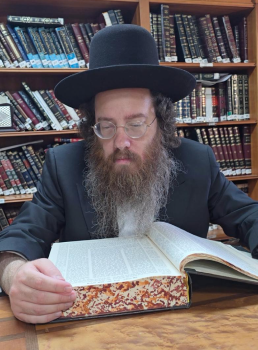
Educational Insights from Parashat Vayeshev — “The Image of His Father”!
This happened when one of the young men would occasionally be absent from the second study session. I tried to find out where he was, but I had difficulty finding a satisfactory answer.
After some time he came on his own and told me: “I go out into the city streets to look here and there…” (and enough said for the understanding reader).
I was surprised. This was an excellent student in every respect. I asked my teacher and master, our teacher, the Gaon Rabbi Yaakov Edelstein zatzal, how to deal with him. He said to me: “You can advise him that whenever he encounters a trial, he should picture before his eyes the image of his father or the image of his rabbi.”
The young man indeed listened to the advice, and to my joy, after a few days he came to tell me that he had rid himself of his improper habit.
This is learned from our parashah.
Yosef the righteous withstands the trial with Potiphar’s wife. In the words of our Sages, many details are brought at length, testifying to the greatness and depth of the trial. The question that arises is: from where did he gain the strength to overcome? From where did he draw the courage and fortitude to refuse and resist?
Our Sages explained (Sotah 36b): At that moment, the image of his father came and appeared to him in the window. He said to him: “Yosef! In the future, your brothers will be inscribed on the stones of the ephod, and you among them. Do you want your name to be erased from among them?” Because of his awe and shame before his holy father, Yosef refrained from the transgression and fled from there with all his might.
It is thus clear that were it not for the image of his father that appeared to him, Yosef would have yielded to the enticements of that wicked woman, and only the revelation of his father’s likeness saved him from sin!
Yosef the righteous could have had many excuses for sinning. After all, his brothers had thrown him into a pit; he had been sold from hand to hand; he had lived for quite a few years in the corrupt Egyptian society; and who knew whether he would ever return home at all. Especially in light of the words of our Rabbis, of blessed memory, that he saw with his ruach hakodesh that part of the future generation of all Israel was destined to come from her. So why did Yosef choose to remain faithful to the education he had received?
“The image of Yaakov his father appeared to him”! In moments of crisis and doubt, Yosef remembered his father, the education
pure, that he had implanted within him, and then he girded himself with courage and strength.
The kind of education is tested not necessarily when the parents are nearby, supervising and watching, but when they are a positive and powerful “image” remembered even in their absence.
Yaakov Avinu, besides being Yosef’s father, was also his primary rabbi, and from him he learned most of his wisdom. Therefore, at that moment when his inclination overpowered him, he saw in his mind’s eye the image of Yaakov warning him against sin; immediately he was filled with awe and shame before him, and he fled and went outside.
Yosef the righteous would ask himself before every action he took and in every trial he faced: “What would Father say about this if he saw me now?” “If I behave in such-and-such a way, how would Father react to it?”
When one pictures the image of a father or a rabbi, one remembers not only the form of his face, but his personality, his inner being, his Torah and his ways; and when this stands before a person’s eyes, it in fact stands before his spirit and gives him the resilience to stand firm.
Similarly, the righteous Gaon Rabbi Shlomo Wolbe zatzal wrote in his book Zeri’ah Uvinyan Bechinuch (“Planting and Building in Education,” p. 16): “Education is a process that must, from the outset, be long-term. Already when a child is two or three years old, one must know and take into account that when the child is fourteen or fifteen, he will be in a very difficult period. In order to pass through the period of age fourteen in peace, he needs to be connected to his parents with a warm relationship… Parents must build a warm relationship with the child, so that when the child reaches adolescence, which is a difficult period, this warm relationship will stand by him and help him.”
Does a Dog Discern Those Who Fear Hashem — Really?
In this connection, I heard from my uncle, the distinguished Gaon Rabbi Yechiel Baruch Elandaf shlita, who related:
“In my youth, when we lived in Tel Aviv, there was a period during which many break-ins and thefts occurred in homes. One of the brothers decided to bring a large dog into the yard of the house in order to deter thieves and unsavory people from approaching our home. Then I noticed a strange phenomenon: every time my father zatzal (my grandfather, the righteous Gaon Rabbi Saadia Elandaf zatzal) would come home, the dog would run away and hide until he had passed! It was astonishing, because the dog was not afraid of anyone; on the contrary, if it knew someone it would jump on him, and if it did not know him it would attack…
Indeed, even an animal withdraws and is frightened before the face of a Torah scholar upon whose face there is fear of Hashem.
However, even one who is not on such levels that the radiance of his face influences and shines upon his surroundings, certainly his very image as a father, as an educator, as one who charts a path, as a person of stature, a person of true values, greatly influences the souls of children and students, who are always searching for and wishing to attach themselves to a valued figure in their world whom they can follow. This greatly obligates us to be such a figure, as Rabbi Samson Raphael Hirsch wrote in his book Foundations of Education (vol. 2, p. 55): “Forceful parents will not succeed in educating toward patience; irritable parents will not be able to educate toward moderation; coarse parents will not be able to educate toward manners; and cunning parents will not be able to educate toward innocence and honesty. All words make no impression on the child like the living example he sees in his parents and teachers.
And as King Shlomo said in Shir HaShirim: “צְאִי לָךְ בְּעִקְבֵי הַצֹּאן וּרְעִי אֶת גְּדִיֹּתַיִךְ עַל מִשְׁכְּנוֹת הָרֹעִים” — “Go forth in the footsteps of the flock, and pasture your kids by the dwellings of the shepherds.” And they said in the Gemara (Ketubot 67a): “Do not read ‘gediyotayikh’ — ‘your kids,’ but ‘geviyotayikh’ — ‘your bodies.’” That is, what is the way to pasture our kids by the dwellings of the shepherds? How can one truly merit seeing that the kids — meaning the children — continue in the path of the shepherds, the fathers, and do not abandon it?
When you pasture your kids — your “bodies”!!!
When the person himself, his “body,” his body and image, walks in the paved path of the fathers from generation to generation, then he will merit seeing the kids (your kids) continuing on that same path.
The image — is not merely a symbol, but the very designation of a person’s essence, his personality, his way of life, and the path he represents in the world.
This is our responsibility as parents and educators — to be a personal example of an “image.” And then it will surely “save him from sin.”
Source
Rabbi Michael Zacharyahu
Spiritual director at the Torat David Yeshiva Gedolah and chairman of the Legion of the King organization