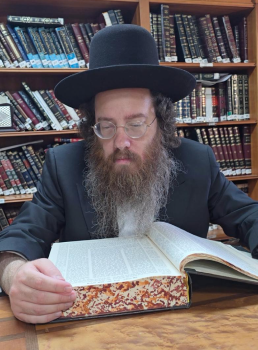
The required length of the hair of the sidelocks (peot)
Question
Answer
Shalom u’vracha.
The ruling of our teacher, HaRav HaGaon Rabbi Amram Fried shlita:
One should leave five millimeters, and one who is lenient and leaves one millimeter — we do not protest against him.
See the sources.
Source
אזמרה לשמך 163
Source of the ruling: Responsa Ktav Sofer (Yoreh De’ah 181) and Biur Halacha (siman 551).
In the Shulchan Aruch (Yoreh De’ah, siman 181, se’if 3) it is written: "אינו חייב אלא בתער (he is only liable when using a razor — this is the opinion of the Rambam), ויש אוסרים במספרים כעין תער (and there are those who forbid scissors that cut like a razor — the opinion of the Rosh), ויש לחוש לדבריהם (and one should be concerned for their words)."
Ktav Sofer writes in his glosses to the Shulchan Aruch (ibid., se’if 9): "ובאורך שיעור כל שערה כדי לכוף ראשו לעיקרו" (the length of each hair must be such that one can bend its tip back to its root). So too is written in Responsa Rabbi Akiva Eiger (cited in his novellae to tractate Makkot 20), and this is also precise from what the Rambam writes (chapter 5 of Hilchot Nezirut, halacha 11): "נזיר שגלח שערה אחת לוקה בין בתער בין בזוג והוא שקצצה מעיקרה כעין תער וכן אם תלשה בידו לוקה, אחד המגלח ואחד המתגלח שנאמר תער לא יעבור על ראשו, ואם הניח ממנו כדי לכוף ראשה לעיקרה אינו לוקה שאין זה כעין תער" — (A nazir who shaved off even one hair incurs lashes, whether with a razor or with scissors, provided that he cut it from its root like a razor; similarly, if he plucked it out with his hand he incurs lashes. Both the one who shaves and the one who is shaved are liable, as it is said: "A razor shall not pass over his head"; but if he left from it enough to bend its tip back to its root, he does not incur lashes, for this is not like a razor). From the Rambam’s words it is clear that in order that it not be considered that the nazir cut with scissors "like a razor", he must leave a length sufficient to bend the tip of the hair back to its root, and apparently the same applies here.
The measure of "to bend its tip back to its root" is treated stringently as 5 mm (on most hair‑clippers this corresponds to guard no. 2, and on some machines to no. 3).
However, for those who are lenient and leave 1 mm (on a hair‑clipper, guard no. 1) one does not protest, since this appears to be the view of several Rishonim (early authorities), and it also seems somewhat from the Biur Halacha (siman 551) that it suffices to leave even a minimal remainder of hair. The rationale is that the Tannaim dispute (Gemara Niddah 52b) what the required length of hair is: whether it is "enough to bend the hair" or "enough to nip it with the fingernail" [which is a smaller measure]. Out of doubt with regard to a nazir we act stringently in accordance with the larger measure — "enough to bend". But regarding the pe’ot of the head, where the prohibition of encircling the pe’ot of the head applies only with a razor, and according to the Rambam (cited in Yoreh De’ah 181:3) it is permitted to cut with scissors that cut like a razor, it is certainly not necessary to leave a length "enough to bend". Only according to the view of the Rosh (ibid.), who forbids encircling the pe’ot with scissors that cut like a razor, is there room to say that one must leave enough to bend. Therefore the Biur Halacha ruled that for the pe’ot of the head it suffices to leave hair of any length whatsoever, as long as something remains, whereas with respect to naziriteship the Rambam rules that one needs the measure of "enough to bend".