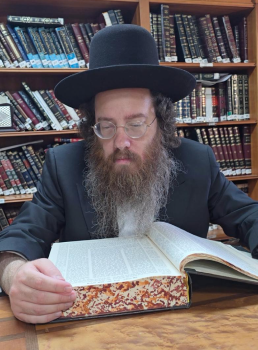
The Sanctity of the Synagogue
The Torah states: “ונתתי את עריכם חרבה והשמותי את מקדשיכם ולא אריח בריח ניחחכם” (Vayikra 26:31) — “I will make your cities desolate and lay waste your sanctuaries, and I will not smell your pleasing aromas.” The Mishnah (Megillah 28a) expounds regarding a synagogue that was destroyed: “Their sanctity remains even when they are desolate.”
The Law of Synagogues in Our Time That Are Built on Condition
The Gemara in Megillah (28b) states: “The synagogues of Babylonia were made on condition; nevertheless, one may not behave frivolously in them. What does this refer to? Calculations.”
We find three opinions among the Rishonim as to which synagogues a condition is effective for.
1. A condition is effective only for a synagogue in Babylonia (but not in Eretz Yisrael), and only after it was destroyed (but not while it is standing) [Tosafot (Megillah ad loc.) and the Rosh (Megillah, ch. 4, §7)].
2. A condition is effective to use the synagogue even while it is standing, but it permits use only in a pressing situation [Ramban (Megillah 26b), Ran (9a in the pages of the Rif), Rashba (Responsa, vol. 4, §278)].
3. A condition is effective to use the synagogue even while it is standing, and even not in a pressing situation [Rashi (Megillah ad loc.), Or Zarua (vol. 2, §388)].
The Acharonim disagree (see Mishnah Berurah §151:32) whether an explicit condition must be made, or whether even if no explicit condition was made, it is presumed as though it was made on condition; in practical halacha, it appears that we are lenient in this matter.
Regarding synagogues in Eretz Yisrael, the Biur Halacha (there, s.v. “but in synagogues”) inclined to be lenient if one explicitly stipulated.
In practice, in our time many have the custom to stipulate at the time of building the synagogue [and perhaps the condition is effective even after completion of the building, before the beginning of use of the synagogue], that it should be possible to use it for mundane purposes.
If they did not explicitly stipulate — although simply it appears that the sanctity of a synagogue applies, nevertheless, since in our time it is customary to hold meals in the synagogue, there is room to be lenient and consider it as though they explicitly stipulated, and the “heart of the beit din” stipulates on their behalf (see below what is explained in the name of Responsa Divrei Chaim).
Although there is a virtue in praying in a synagogue (Berachot 8a; Orach Chaim §90:9), and through the condition the sanctity of the synagogue is lighter, nevertheless a condition is made so as not to stumble in the prohibition of eating, drinking, and matters that involve some frivolity.
The Shulchan Aruch (§151:11) rules that a condition is not effective for a built synagogue, nor even in Eretz Yisrael [like the first opinion], while the Biur Halacha writes that one may rely leniently on the opinion of the Ramban, that a condition is effective in a pressing situation.
Which uses are permitted in a synagogue built on condition:
1. Mundane uses that involve no frivolity at all, such as calling one’s friend, resting, and the like — a condition is effective everywhere, even in Eretz Yisrael (see Biur Halacha, s.v. “but in its settlement,” who questions this).
2. Eating and drinking — which involve some frivolity, and regarding these the three opinions mentioned above were stated.
3. Great frivolity — such as making a bathhouse in the synagogue, or a restroom, or calculations not related to a mitzvah, laughter and frivolity, and idle talk — all these are forbidden even in a synagogue made on condition, and even when it is in ruins (Biur Halacha, s.v. “but in synagogues in Eretz Yisrael,” and Shaar HaTziyun §20).
Eating and Drinking in the Synagogue
1. It is forbidden to eat and drink in the synagogue, and even drinking water is forbidden.
2. Those who learn all day in the beit midrash: according to the Shulchan Aruch, they may eat and drink in a pressing situation, or if eating outside would disturb their learning; according to the Rema, it is permitted even not in a pressing situation, because the beit midrash is their home.
3. In our time, the custom is to be lenient even for those who do not learn all day, but only come to Torah classes and eat a little and drink. The reason is that they rely on the Ramban’s opinion (cited above), that a condition is effective even for an active synagogue in a pressing situation, and synagogues in our time are made on condition [as explained above]; also, it is a mitzvah need, so that they should not stop their learning (Biur Halacha there, s.v. “and one does not eat”).
4. Eating and sleeping in the synagogue for the needs of the synagogue — are permitted. Therefore, one may sleep in the synagogue on the night of Yom Kippur in order to guard the candles, and it is also permitted to eat on Simchat Torah, at the bringing in of a Sefer Torah, and at the dedication of the synagogue (Shulchan Aruch there §4; see Aruch HaShulchan there §6).
Eating at a Mitzvah Meal in the Synagogue
A seudat mitzvah is permitted in the synagogue and in the beit midrash (Yerushalmi Pesachim, ch. 1, halacha 1; Tosafot, Pesachim 101a; Shulchan Aruch §151:4).
The Rishonim disagree whether only a small mitzvah meal is permitted, such as the meal for the intercalation of the month, which consisted only of bread and legumes, while large meals, such as a siyum of a tractate, a brit milah meal, pidyon haben, and a bar mitzvah, are forbidden (Hagahot Semak, mitzvah 6; Magen Avraham there §5; Mishnah Berurah there §20).
There are Rishonim who permit even large meals and even Shabbat meals (depending on the version of the Yerushalmi Pesachim there, Or Zarua, and Sefer HaManhig).
The Mishnah Berurah (there §20) writes that the custom is to be lenient and hold a siyum HaShas meal in the beit midrash when there is no other place; one should not protest, for they have what to rely upon.
The reason is that according to the Ramban, Ran, and Rashba, a condition is effective even while the synagogue is in use in a pressing situation, and according to Rashi and the Or Zarua even not in a pressing situation (as cited above), and there are also opinions that even a large seudat mitzvah is permitted, as explained (Shaar HaTziyun there §14).
A “shalom zachar” meal — some have the custom to hold it in the synagogue, since it is a mitzvah meal that does not involve drunkenness, and therefore it is permitted in the synagogue.
However, there is room to discuss that since the baby is not present there, it is not obvious that this is a mitzvah meal; and there is also room to discuss that a shalom zachar is a mitzvah meal not connected to the synagogue.
Nevertheless, since it was explained that we rely on the Ramban’s opinion that the condition is effective for synagogues even while they are in use in a pressing situation, therefore one may be lenient if there is no other place; it is proper to hold it in the women’s section, and they should be careful not to speak idle matters.
Regarding other mitzvah meals [brit, pidyon haben, bar mitzvah, sheva berachot, and Shabbat meals] — one should not be lenient unless there is no other possibility; it is proper to hold them in the women’s section and to be careful about idle talk. [Regarding seudah shelishit, the custom is more lenient, since it is a small meal and there is not such a concern of drunkenness.]
In Responsa Divrei Chaim (Choshen Mishpat, vol. 2, §32), he wrote that the beit midrash of tzaddikim is stipulated so that the sanctity of a synagogue should not take effect upon it at all [this differs from the condition made in synagogues, explained above, which is effective regarding allowing mundane uses; here the condition is that no sanctity should take effect at all]. Therefore it is called “shtieblach,” meaning a private house that is also used for Torah and prayer, and it has no sanctity at all, so one may eat and drink there as usual. This requires further practical analysis.
Mundane Speech in the Synagogue
The Shulchan Aruch (§151:1) rules: “In synagogues and batei midrash one may not behave frivolously, such as laughter, mockery, and idle talk” (Megillah 28a).
The Mishnah Berurah (§2), in the name of the Pri Megadim, writes that even mundane conversation for the purpose of livelihood is forbidden in the synagogue [and we do not say that livelihood is a mitzvah and it is permitted to speak about it in the synagogue; this requires analysis from §248 and §531].
The Shaar HaTziyun (§20) writes that a condition is not effective for laughter, lightheaded mockery, and idle talk.
The Mishnah Berurah (§6) writes that even a Torah scholar is forbidden in laughter, mockery, and idle talk, because even a Torah scholar is commanded regarding awe of the Sanctuary.
Accordingly, it must be clarified whether it is permitted to speak about changing money and the like in the beit midrash, since even a Torah scholar is forbidden to speak even for livelihood needs, and even in synagogues made on condition.
It seems that short matters [where, if one were to go outside to do them, it would cause bittul Torah] may be dealt with and spoken about in the beit midrash by a Torah scholar, but lengthy matters are forbidden even for livelihood needs.
However, the Aruch HaShulchan (§151:5) writes: “One should wonder at the fact that nowadays people are lenient to speak in the synagogue and beit midrash after prayer about various mundane matters, and it has become treated as permitted. It seems to me that they follow the opinion of the Ramban, which will be explained, that the synagogues of Babylonia are made on condition even while in use for matters that are necessary, and we consider this a necessity, each person according to his circumstances.”
It is clear from his words that matters that are not truly idle may be spoken about by a Torah scholar in the beit midrash; however, from the above words of the Mishnah Berurah it appears not so.
Mitzvah-related speech is permitted in the synagogue [even without a condition].
It is permitted to speak about matters involving kindness, and it is also permitted to collect charity, to engage in returning a lost object, and any matter involving kindness and help to another [such as answering one’s friend what time it is] (§151:1).
It is permitted to say “shalom” (§66; Eliyah Rabbah there §2; §89), and it is also permitted to say “yashar koach” (Mishnah Berurah §128:60).
The Laws of Using a Synagogue as a Shortcut (Megillah 29; Orach Chaim §151:5)
It is forbidden to enter a synagogue in order to shorten one’s way.
If there are two adjacent synagogues — it is permitted to pass through the first in order to enter the second.
If one says a verse, it is permitted to shorten the way (Kol Bo and Orchot Chaim, laws of the synagogue; Biur Halacha §151; see Or Sameach, Laws of Prayer, ch. 11, who forbids).
Even if one’s purpose in shortening the way is to fulfill a mitzvah, if the fulfillment of the mitzvah is not inside the synagogue, it is forbidden (Biur Halacha there, s.v. “to shorten”).
It is permitted to enter a synagogue for the purpose of a mitzvah even without saying a verse.
It is explained in the Gemara (Megillah there) and in the Shulchan Aruch (there) that if the path existed before the synagogue was built, it is permitted to shorten one’s way through the synagogue; from this we learn the following laws:
If there is an inner room in the synagogue that was built at the time the synagogue was built, one may enter it through the synagogue. Therefore, if there is a kitchen or restroom whose only entrance is through the synagogue, one may enter there through the synagogue.
If the restrooms or kitchen were added after the synagogue was built, and the entrance is only through the synagogue, then in order to enter them one must say a verse; but if one comes to the synagogue in order to pray or learn, since one must relieve oneself before prayer and learning, it is permitted even without saying a verse.
A Mitzvah to Leave the Synagogue Through the Second Entrance
It is explained in the Gemara (Megillah 29) and in the Shulchan Aruch (there) that if a synagogue has two entrances, it is a mitzvah to enter through one entrance and leave through the second. This law applies only when one enters to pray; but if one enters to learn and the like, this mitzvah does not apply.